Meiji Economic Growth
key terms
- Matsukata Masayoshi
- Matsukata deflation
- Shibusawa Eiichi
- zaibatsu
Three key aspect of Meiji economic growth:
1) Agricultural population does not change:
- there is no shift of population from agriculture to manufacturing
- no growth in Japanese farming population
BUT agricultural production soars
Year |
Agri production index |
| 1873 |
28.6 |
| 1890 |
50.1 |
| 1900 |
65.3 |
| 1921 |
100 |
how is this possible?
technology is largely diffusion of domestic best methods (soy bean cake, fish cake, better seeds) only some is chemical phosphate fertilizer
the gov. is important here because of agricultural colleges and agricultural societies
2) public investment in more than half of total investment -- industrialization is state led BUT not state-owned
3) most investment is in traditional technologies -- esp. spinning weaving
Japan’s leap to 1st world status occurs c. 1920
in 1894-98 Japan’s imports = 34% manufactured goods vs. 22.5% raw materials
in 1921-25 Japan’s imports = 18% manufactured goods vs. 49% raw materials
primary new import in raw cotton from China AND growing export is textiles
in 1894-98 Japan’s exports = 26.5% manufactured goods / 10.7% raw materials
in 1921-25 Japan’s exports = 38.6% manufactured goods/ 6% raw. mat.
Industrialization
What role did the state play in the growth of industry during the Meiji era?
1870s and early 1880s were a period of experimentation
The gov. bought or sponsored factories and attempted to run these as gov. enterprises
- this was in large part a continuation of Tokugawa policy
- Satsuma, for example, had run its own iron foundry
- BUT this sort of direct gov. ownership was short lived
WHY? -- one key reason is that many of these enterprises failed -- they cannot be run at a profit
- the gov sells off many of these companies in the 1880s
- many entrepreneurs benefit by grabbing these companies for cheap
- this leads to some of Japan’s first government scandals
From the 1880s on we can discern three levels of econ involvement
1) textile industry -- (cotton spinning, silk spinning and weaving)
- this is a major growth industry in the late 1800s, much early Meiji growth occurs here
- the industry is almost entirely private -- the gov. sold off it unsuccessful mills
- these were supplanted by private mills such as Shibusawa Eiichi spinning factory -- Eiichi's factory had over 10,000 spindles and used electric light -- it was a state of the art plant -- and generated considerable profits
- textiles are extremely import because they are Japan's major export during the Meiji era -- in 1913 3/5 of Japan's exports are cotton or silk -- Japan's exports are led by the private sector
a) silk and cotton were both industries carried over from the Tokugawa era -- and despite the importance of mechanized power driven mills, traditional industry remained important
in 1913 -- for examples, about 75% of Japan's raw silk was machined produced -- there were over 250,000 hand reeling silk establishments --in contrast to about 5,000 machine-reeling establishments -- 2% of factories are producing 75% of production
Images and photographs of the Tomioka Spinning Factory - Meiji era
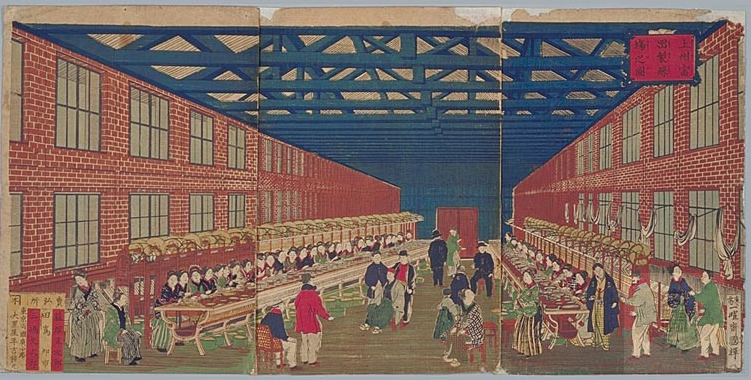 |
| print by Utagawa Kuniteru c. 1873 from Waseda University collection |
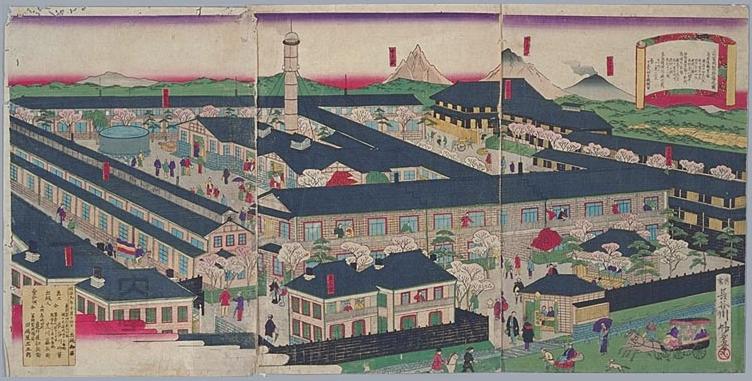 |
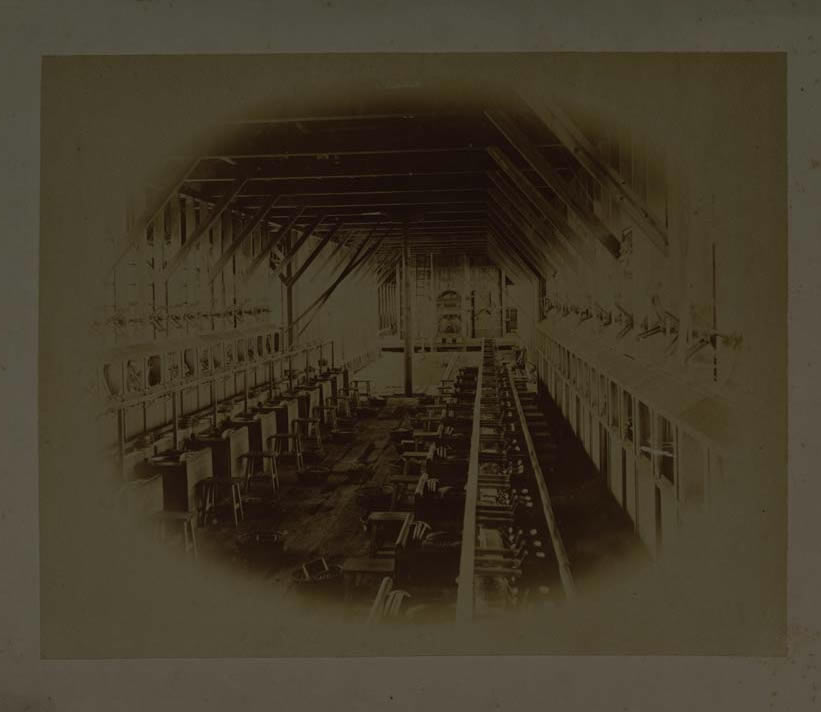 |
| Hasegawa Kawatake print of factory |
Photograph from Tokyo National Museum |
contrast this with older physical structures
b) two different markets -- Japanese size cloth vs. European sizes
problem of dualism -- a rural, low-wage sector coexists with a modern, more industrial sector -- small scale mills carried over from the Tokugawa period
c) the work-force is almost entirely young women -- often they are sent to the factory - to supplement a farm family income -- their employment tends to be temporary --
workforce turnover is over 100% (see Gordon)
they are never unionized or organized in any effective -- this is a powerful check on wages -- factory conditions were awful/brown lung/as awful as US or UK?
2) shipping and shipbuilding
an intermediate case -- the gov. subsidizes and protects the industry but attempt direct ownership
a) foreign shipping companies are barring from trade between Japanese ports -- government agencies also favor domestic shippers
b) the government indirectly subsidizes shipping through postal contracts
special allowances were had for companies which purchased new faster ships, especially if built in Japan
some estimates suggest that over the period 1900-1914 - about 77% of the total net earning of large Japanese shipping companies came from gov. subsidies
c) shipyards were directly subsidized -- special high rates were paid for modern, large, fast ships
d) but traditional ships remain extremely important in less critical routes -- coal shipping, for example, is still carry largely by traditional sailing ship into the 1920s
specific case -- Mitsubishi shipping
Mitsubishi started when Tosa, after the Restoration (1871) sold-off the foreign ships it had bought to Iwasaki Yatarō
Iwasaki later bought a small private line and some surplus gov ships
he gov. steered contracts his way and guaranteed private investors an 8% dividend
3) iron and steel
this is an instance of direct gov. intervention -- since no private entrepreneur has sufficient capital -- the gov. builds the Yawata steel works in 1890
this helps cuts Japanese dependence on foreign steel -- the key incentive here is strategic -- in order to be a world power Japan must be able to produce its own steel
even in 1929 -- steel production is only 1/4 that of textiles
IRRESPECTIVE of the industry -- perhaps the most important contribution the Japanese government made to economic growth was the establishment of a secure financial base
MACRO-ECONOMIC issues
1) stable currency
- Japan attempts to go on gold standard in 1871 - yen is set equal to dollar as 1.5 g gold
- but this leads to outflow of specie
- Japan has enormous expenses during the 1870 and 1880s -- the suppression of the Satsuma rebellion and the commutation of samurai stipends (¥210 million)
- Government borrow internationally, issues bonds, and prints money
- Problem — enormous bond issues and printing money tend to lead to a lose of faith in bonds and currency
- By 1881 there is the real prospect that the yen will become like a unreliable currency
Yen is worth only 55% of its face value in silver
- 1881 the finance minister, Matsukata Masayoshi, undertakes a drastic devaluation of the yen
- this is ultimately a tremendous success (1897 -- goes to gold standard)
- But in the interim, a devaluation of the currency leads to a recession –
- Reduce money supply from 150 million to 120 million
- between 1880 and 1884 prices fall by 25%
- Raw silk price falls by 50%
- This is particularly devastating to small commercial farmers
- like the mulberry leaf growers, who grow the mulberry leaves to feed to the silkworm
- Negative effects of the Matsukata deflation can be seen in a increase in rural tenancy
- BUT yen is made convertible into silver in 1885
- Japan adopts gold standard in 1897 - WHY this data?
2) the establishment of a stable banking system
the Bank of Japan is founded in 1882 and a series of other semi-gov. banks are founded during the late 1880s and 1890s (Yokohama Specie bank -- foreign exchange), Hypothec Bank (long-tern low interest development loans) finally in 1900 the Industrial Bank of Japan
the capital is these banks is largely private - but the are closely watched are regulated and used by the gov. -- this is an example of early Japan Inc. -- also investment by Imperial Household
3) investment in "non-sexy" infrastructure -- basic roads and port facilities
Where did Meiji businessmen come from?
This depends partly on sector
industries such as non-mechanized silk spinning are characterized by continuity
BUT many of the new industrialists are samurai
much of the old merchant class cannot adapt to new market conditions -- much of their success was based on old political connections (with domain gov. which didn't exist anymore)
a new term -- jitsugyōsha 実業者 "man of affairs" is coined to characterize this new class
Zaibatsu
these are large, vertically integrated companies or families of companies
the major zaibatsu were Mitsubishi, Mitsui, Sumitomo and Yasuda, sometimes Dai-Ichi
these existed independently for over 100 years -- consolidated only after 1990s financial crisis
2002 – Mizuho Bank is created in merger of Dai-Ichi and Yasuda
2002 - Sumitomo-Mitsui financial group
Large conglomerates grow as a proportion of the economy
1909 companies capitalized at ¥5 million were 0.3% of total companies BUT 36% of capital
1929 companies capitalized at ¥5 million were 1.6% of total BUT 65% of capital
in 1929 the big five also were 19% of banking capital
Case of Mitsui
origins in a Tokugawa merchant house, added overseas trading in 1876, then coal mining, textiles, paper manufacture, sugar refining and shipping
gets exclusive government contracts for sale of coal from Miike mine
when the occupation authorities began dismantling Mitsui in 1946 it consisted of:
Mitsui trading company
Mitsui chemical company
Toyo High Pressure
Toa Synthetic Chemical
Toyo Soda
Shimane Chemical
The Imperial bank
Mitsui precision machinery
Mitsui shipbuilding
Mitsui Agriculture and Forestry
Mitsui Real Estate
Toyota Motor Car
Onoda Cement
Maruzen Petroleum
Showa Aircraft
Oriental Cotton Trading
Mitsui Lumber
Taisho Marine and Fire Insurance
Sanki Industrial
Daito Woolen
Nippon Flour
Mitsui Warehouse
Sanyo Oil and Fat
Mitsui Wooden Shipbuilding
Mitsui Shipping
Toyo Shipping
Taiyo Shipping
Mitsui Coastwise
Saikai shipping
Horai Tanker Shipping
Mitsui Mining
Kamanishi Mining
Yamato Mining
Mitsui Light Metal
Contrast horizontal vs vertical intergration